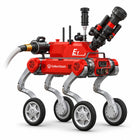
- Patrols on Its Own Autonomous navigation along set routes and intelligent obstacle avoidance turn the wheel-leg E1-W into a patrol robot.
- Wheels for Distance Up to 6 m/s on firm ground and more than 15 km per charge cover large sites in one run.
- Legs for Everything Else At a kerb, ramp or loading platform the legs take over, for slopes of 30° or more and platforms up to 100 cm.
- Carries Inspection Payloads It moves with 30 kg on board and supports 100 kg standing, powered from 48 V and 24 V outputs.
- Recognition and Interaction Voiceprint and gesture recognition, motion and face anomaly recognition and cluster management support multi-robot patrols.
- Always Ready Autonomous charging and a low-power standby of a year or more with remote wake-up let it wait on site for the next patrol.


Description
The Galileo E1-W Standard Edition is the wheel-leg member of Galileo's mid-size E1 series, made for inspection routes that run for kilometres on paved paths but are broken by kerbs, ramps and raised platforms. It rolls along the long stretches and steps over what wheels cannot. The Standard Edition adds intelligent obstacle avoidance and autonomous navigation to the Basic edition's hardware, so a patrol runs without anyone steering it.
On firm ground it reaches 6 m/s, and a 30 Ah, 1,440 Wh battery at 48 V gives 2.5 to 4 hours and a cruising range of more than 15 km per charge. On its legs it climbs slopes of 30° or more and steps up onto platforms up to 100 cm high, 20 cm more than the legged E1. It stands 995 × 537 × 630 mm, weighs 60 kg, carries 30 kg while moving and supports 100 kg standing.
Inside is the E1 series' pair of computers, an 8-core ARM with 8 GB RAM and 64 GB SSD and a 4-core x86 with 16 GB RAM and 256 GB storage. Cameras, thermal imagers, gas sensors or radios connect over Ethernet, USB and Type-C and draw power from the 48 V and 24 V outputs, and dual-band Wi-Fi 6, Bluetooth 5.2 and an app link it to the control room. Multi-target recognition and cluster management let several robots share a site.
Pick the E1-W for substations, rail depots, tunnels and industrial campuses where speed over long, mostly paved routes matters most; the legged E1 Standard is narrower and runs up to 4.5 hours for stairs and grating. The E1-W is not explosion-proof. Sensors, inspection payloads and the ingress protection rating for your site are confirmed in writing with the quotation.
Key Capabilities
- Patrols on Its Own: Autonomous navigation along set routes and intelligent obstacle avoidance turn the wheel-leg E1-W into a patrol robot.
- Wheels for Distance: Up to 6 m/s on firm ground and more than 15 km per charge cover large sites in one run.
- Legs for Everything Else: At a kerb, ramp or loading platform the legs take over, for slopes of 30° or more and platforms up to 100 cm.
- Carries Inspection Payloads: It moves with 30 kg on board and supports 100 kg standing, powered from 48 V and 24 V outputs.
- Recognition and Interaction: Voiceprint and gesture recognition, motion and face anomaly recognition and cluster management support multi-robot patrols.
- Always Ready: Autonomous charging and a low-power standby of a year or more with remote wake-up let it wait on site for the next patrol.
This model is offered on a quotation basis. Configuration, accessories, integration scope and delivery schedule all change the final figure, so pricing is confirmed per project rather than listed.
Buying through Robotix Market
This unit is sourced new through established distribution channels and ships worldwide with the manufacturer warranty. Technical support is coordinated with the manufacturer's own service network. Deployment scope, configuration, and commissioning responsibilities are agreed as part of the quotation, and on-site installation is not included in the product price.
Features
Specs
| Brand | Galileo |
|---|---|
| Model | E1-W Standard Edition |
| Product Type | Mid-size wheel-leg quadruped robot |
| Edition | Standard: intelligent obstacle avoidance and autonomous navigation |
| Dimensions (L × W × H) | 995 × 537 × 630 mm (standing) |
| Weight | 60 kg |
| Body | Aluminium alloy and high-strength industrial plastic |
| Speed | 0 to 6 m/s, adjustable |
| Runtime | 2.5 to 4 hours |
| Cruising Range | More than 15 km |
| Slope | 30° or more |
| Platform Step-Up | Up to 100 cm |
| Continuous Walking Load | 30 kg |
| Maximum Standing Load | 100 kg |
| Battery | Lithium, 30 Ah, 1,440 Wh, 48 V |
| Charging | Autonomous charging; charger input 100 to 240 V |
| Standby | Low-power mode of 365 days or more, remote wake-up |
| Computing | ARM 8-core, 8 GB RAM, 64 GB SSD, plus x86 4-core, 16 GB RAM, 256 GB |
| Interfaces | Ethernet, USB, Type-C; 48 V and 24 V power outputs |
| Wireless and Control | Dual-band Wi-Fi 6, Bluetooth 5.2, app |
| Ingress Protection | Confirm at quote |
| Operating Temperature | -20 °C to 55 °C |
| Explosion Protection | No |
| Sensor Package | Confirm at quote |
| Warranty | 12 months |
Industries
Frequently Asked Questions
The wheel-leg version of Galileo's mid-size E1 quadruped, configured with autonomous navigation and intelligent obstacle avoidance.
Intelligent obstacle avoidance and autonomous navigation. The hardware specifications are the same.
Up to 6 m/s on firm ground, with a cruising range of more than 15 km and 2.5 to 4 hours per charge.
It handles slopes of 30° or more and steps up onto platforms up to 100 cm high.
No. The E1-W is not explosion-proof.
It is offered by quotation. Configuration, quantity and delivery are confirmed per project.
Recently Viewed
You haven't viewed any products yet.